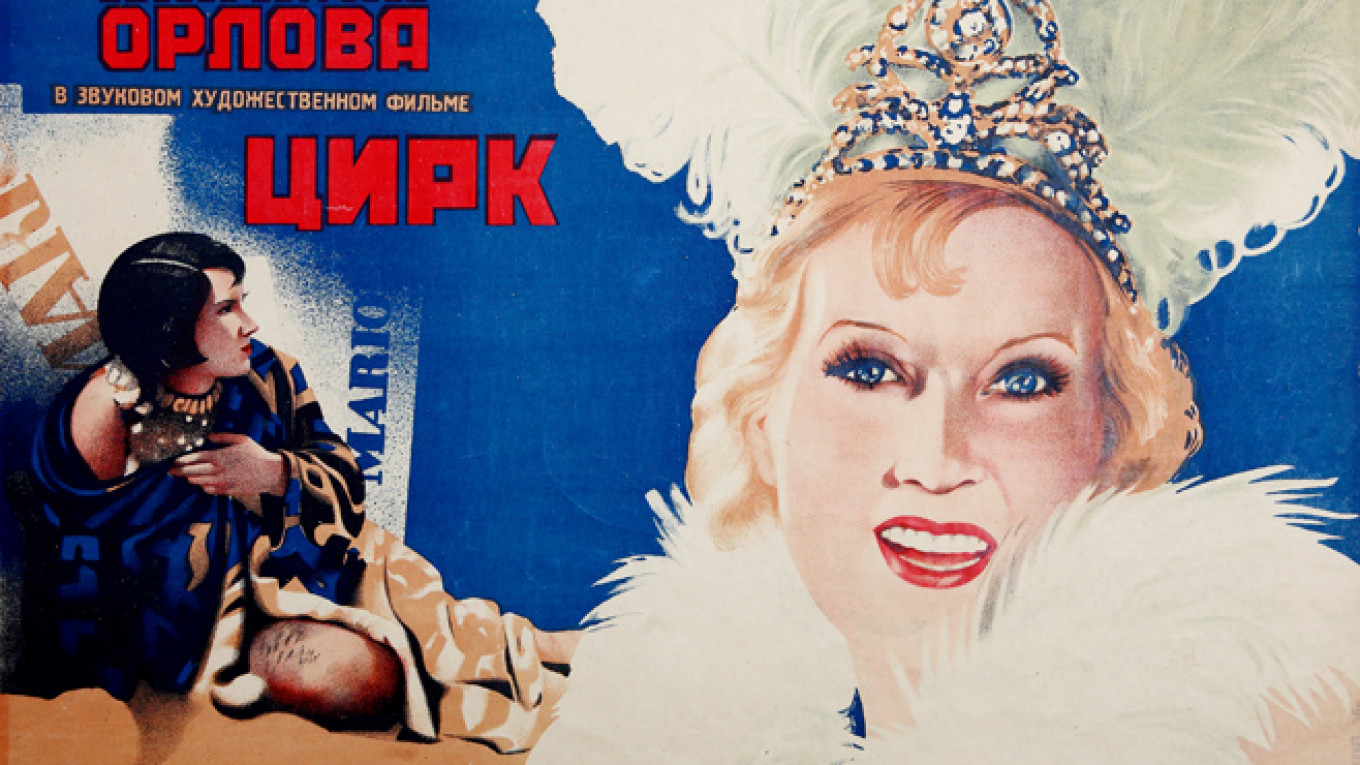
Life has become better, life has become more fun! Come join the circus. We’ve got everything figured out over here. Our economic system is perfect and is to the benefit of all. Our cultural landscape is also perfect, everyone is accepted as equal. Perfection has been achieved and all you need to do understand. Marion Dixon, an outsider, is not quite ready for the utopia that she finds herself in. Forced into her new life because of her old, she goes on the hero’s journey through Martinov into the land of consciousness. There are two key scenes in the film that exemplify this theme. When Martinov and Marion are singing “Song of the Motherland” together and the ending of the film, in which Marion last step into the Vanguard is taken.
The first scene opens with a crane shot looking over Moscow and Martinov’s voice proudly singing. The shot hangs over the city square for a moment, as the lyrics of the song describe the importance of “our man” and his “overwhelming pride.” These lyrics are very clearly sung over a shot of the city to show the people are as important of the pride of the nation as “our man” is. The camera dollies back into the hotel framing the door through which the city is shot and flowers blowing in the breeze. The flowers of life are gently blowing in the breeze as the lyrics “each day is better than the previous one” are sung. The shot sells the ideology along with the lyrics. The city is running as it should, the weather is perfect, flowers blowing the breeze and inevitability of soviet perfection is on full display with no characters in the scene yet. The camera pans left across to find the Martinov is singing to Marion, rather, teaching her the lyrics to the song. The song itself is a monument to socialism and to Stalin himself. It describes the ideology colorfully in song, a common way for young children to learn. Here we find some of the “edutainment” of socialist realism. Like a child, Marion is being taken to school in the scene. Not only a vessel for her to learn the language, as she learns and sings the song she is slowly convinced of its ideology. She miraculously learns, understands, and sings it back to Martinov. Martinov sits proudly and sings with conviction, the song embodies his commitment as well. As he turns the song over to her, she sings with glee until her child begins crying in the other room. She nervously sends the help away because she is afraid Martinov will react as the Americans did. Her journey is not complete yet, as she shrugs off the child and takes over at the piano. She has yet to awaken to miracles of socialism, of course, because we are only twenty minutes into the film. But she has taken her first steps.
Marion finishes off the piano solo with passion and frustration as the child stops crying. She does not look up at Martinov until she nearly finishes her flourish on the piano. She joins Martinov in a close-up. She is positioned lower than he, her head positioned underneath his in the frame. As she makes eye contact with him she looks away. She is not yet worthy of received Stalin’s gifts. This suggests his dominance, and thusly the dominance of the ideology. You need to left your head up to it in order to discover its beauty. The camera tilts down to reveal him reaching out to hold her hand. She may have only taken a small step towards her consciousness and is unsure of how to proceed, however, he reveals that he will literally hold her hand through the process. There is no need to be afraid or unsure, she is where she wants to be even if she does not know it yet. The camera flips over and our heroes stare into the camera. The viewer is now the spectacle of the film for a moment as shimmering lights fill the screen around them. Martinov is smiling, proud, and confident looking in his face, while Marion still seems to have some doubts. The viewer has been officially invited to take up the journey with Marion themselves, even knowing the conclusion is inevitable.
The movie concludes in big fashion. After the much improved Soviet version of “Flight to the Stratosphere” is coming to a conclusion. Von Kneishitz enters the foreground of the frame as the clowns repel from the ceiling. An easy filmic way to show the clownish beliefs the German man holds. Von Kneishitz is the portrait of the fascist enemy, a man without the confidence and joyfulness portrayed in all of the Soviet characters in the film. With Marion’s child in hand, he makes his way around the circle being chased by the circus director and others. He stops to address the crowd as Marion runs to him, attempting to stop him from revealing her shameful truth. However, the awakening that both characters are about to go through is enlightening. He makes his proclamation to the crowd, declaring the creep Marion Dixon has been “the mistress of a negro!” Marion runs off, still expecting the worse as von Kneishitz stands near the top of a set of stairs holding the child in his arms. He is framed similarly to the newsreel shots of Adolf Hitler standing over the people delivering his messages to the crowd. Von Kneishitz has presumed some authority over the people he is speaking to, giving an opposition to the ideology of both the film and socialism. His passionate yet uneducated plea to the crowd goes almost completely unnoticed. He is approached by Ludvig, the circus director, who asks a simple and poignant question, “What’s the problem?” Von Kneishitz pleads his case again, this time not to fall on such deaf ears. Ludvig asks again, “So What?” The racial issues that von Kneishitz assumes in his world do not apply here. His face is struck with disappointment and almost regret. The child, who had spent every moment in his arms crying, has now slipped away into the crowd of people. He is no longer crying as he makes his way to the people calling out to him. Von Kneishitz tries to grab the child again, only to be foiled by the Soviet citizens. Marion’s son has also changed his demeanor. As he is passed amongst the crowd, close-ups of him show his happiness. He is smiling and laughing, happy to be away from the arms of a German and in the arms of Russian. It is a small piece of the last scene but serves its purpose to further along Marion’s arrival at the truth. As the child is carefully passed up the stand in the crowd von Kneishitz gives chase until he is confronted by Soviet soldiers. This stops him in his tracks, for there is no way for him (or any army) to stand up to the might of Red Army. He backs away and another close up of his face again declaring his confusion and tucks his tail between his legs and saunters off the stage. There is no response he can muster to contradict this situation. All that can be done is to walk away in shame. There is no place for his ideas in here. Brilliantly, without any violence, he is shooed away because of his faulty and terrible ideas.
Marion, terrified by the ordeal and yet to see what is happening in the stands, buries her crying eyes into a pile of hay. The people begin to sing a lullaby to the child, who is cradled in the arms of a caring mother figure. The people wait in anticipation to see their newborn Soviet citizen passed into their loving, equally minded arms. The mise-en-scene of each of the next many shots has its purpose in showing the meaning of the entire film in just one scene. The child is passed from mother to father, to sailor, carefully showing many different ethnicities in each shot. Most shots are dominated by men with Stalinesque mustaches, an obvious reference to “our man,” Stalin, who was sung about earlier in the film. As the lullaby is winding down, Marion’s child is given back to her. The final tenants of equality shared to her by Ludvig, she has finally accepted her place. It has been there waiting for her all along and all she needed to do was accept it in her heart. She is finally depicted at equal height as Martinov, framed on the steps with her child. Ludvig’s last words in the film are “it’s our pleasure,” showing the joyfulness and how life is better and always getting better in the USSR.
In a parallel to the scene discussed earlier, Marion looks into the camera, this time, convinced of what she feared all along is not a problem here. She begins to sing “Song of the Motherland” again, this time with the conviction she lacked earlier. The viewer becomes the subject of the film once more. She is joined on the stairs by everyone as the film fades into a parade, as her journey is complete. Her transformation from unconscious to conscious turns into causal action, as she takes her place alongside the Soviets, as a citizen, as one who marches through the city square singing the praises of socialism.
THANK YOU FOR YOUR SUPPORT!


 Movie Blind Spot
Leave a comment