What is there to consider when one is a successful and regaled pop singer in Paris in the early sixties? “As long as I’m beautiful, I’m alive,” she says with confidence. A woman whose life is portrayed as easy as long as there are no bumps in the road. Her life is artifice. She is an object. She is whatever captures the attention of the moment. She is, until the clock runs to the end of the time specified in the title, what you might expect of a Parisian pop star.
In the scene when Cleo is home and in expectation of her lover, even a looming distraction as serious as possible cancer, does not sway her from projecting herself as the perfect image of beauty. Cleo is focused on alluring him. Shortly after he leaves the room, she is visibly distressed. She wants a deeper connection. By fixating on how she is viewed by others she seems to have her ability to make a deeper human connection lost in the shuffle.
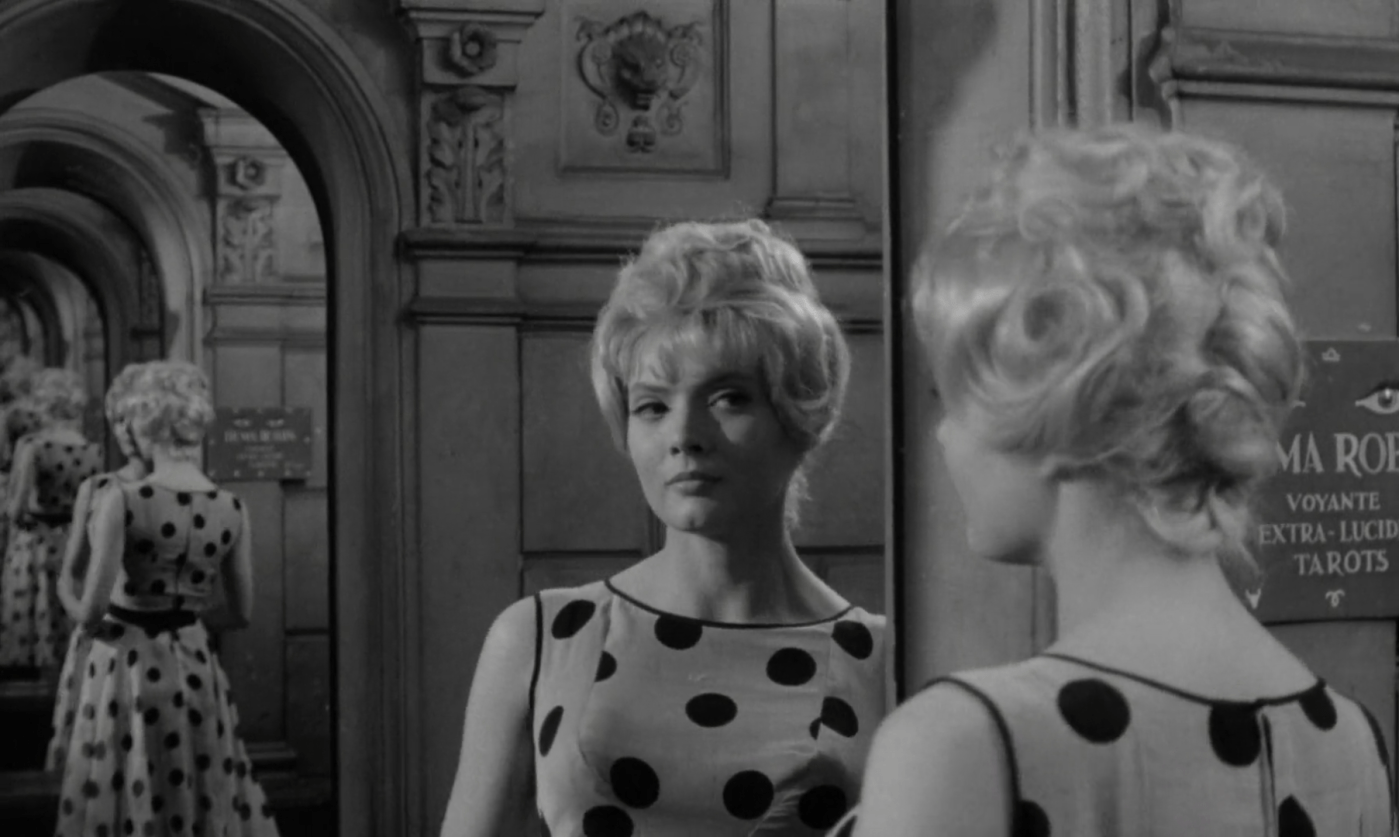
There are several scenes in the film in which Cleo is confronted with her reflection in mirrors. Almost everywhere she goes, there is a mirror for her to look into. Forced to confront herself now on the topic of death, she also must reflect on her life. Cleo is happy to look at herself in the mirror at the beginning of the film, but as the clock ticks down, she becomes more frustrated with the image of herself. She realizes as the film wears on, that the people she surrounds herself see her as an object. She is either just a client of a songwriter, a pretty face and body to marry, a lost girl needing a nanny. As she finally rips her wig off in frustration, she finally begins to realize her self-image may be the most important. The ladder of the film is filled with as many mirrors as the former, only there either broken or wry. Her awakening only begins when her reflected image is shattered, and only her self-image remains.
To further this point, Cleo visits a friend of hers. A nude model surrounded by people recreating her image. There are a lot of people in the room sculpting her and all of the sculptures are different. She is comfortable with her image, allowing it to be recreated, unlike Cleo, who fosters her own internal creation and outputs it accordingly. She is trying to create the ideal output of a woman, not just being the woman she is inside.
Throughout her life Cleo was an object, a character, a spectacle, whatever the situation called for, but never really a person, or herself. Only in the last few moments of the film does she meet someone who has stripped away the similar entrapments. Facing down death in a similar manner, for the first time Cleo, or Florence, gets to be herself, a person. Looked at by a soldier who doesn’t see her as a character, a spectacle or whatever the situation calls for.

 Movie Blind Spot
Leave a comment